

Description
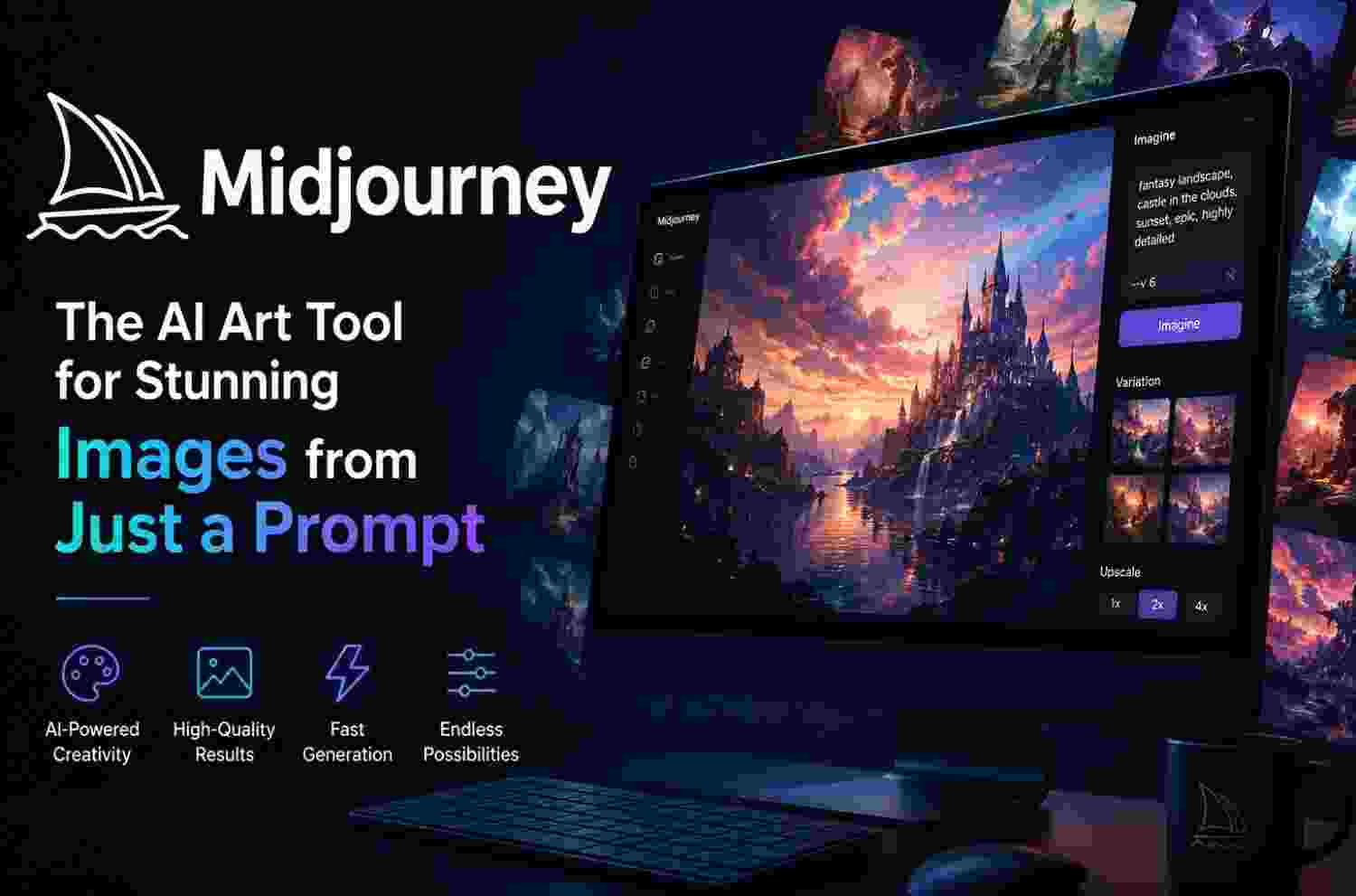
Midjourney has become one of the most recognizable names in AI image generation. It allows users to transform text prompts into highly detailed visuals, making it useful for designers, marketers, content creators, artists, entrepreneurs, and businesses.
But with the rapid growth of AI image generators, the question is no longer simply “Can Midjourney create impressive images?” The more important question is: Is Midjourney still one of the best AI image generators to use?
In this review, we look at Midjourney’s capabilities, key features, strengths, limitations, ideal use cases, alternatives, and overall value.
What Is Midjourney?
Midjourney is an AI-powered image generation platform that creates images from natural-language prompts.
Instead of manually designing an image from scratch, users describe what they want and let the AI generate visual concepts.
For example, you could enter a prompt describing:
A futuristic city at night, cinematic lighting, flying vehicles, detailed architecture, realistic photography
Midjourney can interpret the description and produce an original visual based on the prompt.
This makes it useful for everything from concept art and illustrations to advertising creatives, product concepts, social media graphics, and visual experimentation.
Midjourney at a Glance
| Feature | Midjourney |
|---|---|
| Category | AI Image Generator |
| Primary Use | AI-generated images and creative visuals |
| Input | Text prompts and visual references |
| Best For | Designers, artists, marketers, creators and businesses |
| Image Quality | Excellent |
| Creative Control | Advanced |
| Learning Curve | Beginner to Intermediate |
| Commercial Use | Available depending on plan and terms |
| Style Generation | Excellent |
| Editing | Available through Midjourney’s evolving creative tools |
| Web-Based Workflow | Yes |
Who Is Midjourney For?
Midjourney isn’t limited to professional designers.
It can be useful for a wide range of users.
🎨 Graphic Designers
Designers can use Midjourney to brainstorm visual concepts, explore styles, create moodboards, and develop early creative directions.
📱 Social Media Creators
Creators can generate unique images for posts, thumbnails, campaigns, and other digital content.
📢 Marketers
Marketing teams can experiment with advertising concepts, campaign visuals, promotional imagery, and creative variations.
✍️ Bloggers and Content Creators
Midjourney can help create custom illustrations and featured images for articles.
🏢 Businesses
Companies can explore product concepts, branding ideas, presentation visuals, and marketing creatives.
🎮 Game and Concept Artists
Artists can use AI-generated imagery for visual exploration, environments, characters, and concept development.
👨💻 Developers
Developers can use generated visuals for websites, prototypes, applications, presentations, and product concepts.
Key Features of Midjourney
1. Text-to-Image Generation
The core functionality is simple:
Describe an image → Generate the image.
You can describe:
- Subjects
- Locations
- Lighting
- Camera perspectives
- Artistic styles
- Colors
- Materials
- Atmosphere
- Composition
The more effectively you communicate the desired visual result, the more control you can have over the output.
2. Exceptional Image Quality
One of Midjourney’s biggest strengths is visual quality.
The platform has historically been particularly strong at producing:
- Detailed environments
- Atmospheric scenes
- Stylized artwork
- Character concepts
- Product imagery
- Cinematic compositions
- Fantasy artwork
- Photorealistic-looking visuals
For users who prioritize aesthetics, Midjourney remains one of the strongest options in the AI image-generation market.
3. Artistic Styles
Midjourney is particularly attractive for users who want visually distinctive results.
You can experiment with different aesthetics such as:
- Cinematic
- Editorial
- Minimalist
- Vintage
- Futuristic
- Fantasy
- Surreal
- Anime-inspired
- Architectural
- Fashion photography
- Digital illustration
This makes it useful for creative exploration rather than simply producing generic stock-style imagery.
4. Image References
One of the most useful capabilities for experienced users is the ability to incorporate visual references into the creative process.
Instead of describing everything from scratch, you can use an existing image as inspiration and guide the generated result toward a particular:
- Composition
- Subject
- Visual identity
- Style
- Color direction
This can provide considerably more control than text prompting alone.
5. Image Editing and Transformation
AI image generation is increasingly moving beyond simple text-to-image creation.
Modern workflows can involve generating an image and then modifying or extending it.
This type of workflow can be useful for:
- Removing unwanted elements
- Extending compositions
- Changing parts of an image
- Creating variations
- Experimenting with different visual directions
The result is closer to an AI-assisted creative workflow than a simple image generator.
6. Image Variations
Creative work often requires multiple possibilities.
Instead of settling for the first generated image, users can create variations and explore alternative compositions.
This is particularly helpful during:
- Concept development
- Advertising design
- Character design
- Branding
- Product visualization
- Social media content creation
Midjourney for Marketing
Midjourney can be particularly powerful for marketing teams.
Imagine you need five different concepts for a new campaign.
Traditionally, creating those concepts could require:
- Stock photography
- Graphic design
- Photography
- Illustration
- Multiple rounds of revisions
AI can accelerate the initial ideation stage.
For example, a marketer could generate concepts for:
Luxury Product Campaign
Summer Travel Campaign
AI Technology Advertisement
Restaurant Promotional Campaign
Fashion Brand Social Campaign
The AI-generated concepts can then serve as inspiration or creative starting points.
Midjourney for Social Media
Social media requires a constant stream of visual content.
Midjourney can help creators experiment with:
- Instagram posts
- Pinterest graphics
- Blog visuals
- Campaign concepts
- YouTube thumbnails
- Promotional images
- Creative backgrounds
The major advantage is the ability to create custom imagery rather than relying exclusively on stock photos.
Midjourney for Bloggers
For bloggers, visual content can improve the presentation of an article.
Instead of using generic stock photography, you can generate images tailored to the article topic.
For example:
Article: Future of Artificial Intelligence
Possible visual:
A futuristic AI research laboratory with holographic interfaces, researchers collaborating with intelligent robotic systems, cinematic technology photography.
This allows publishers to create visuals specifically aligned with their content.
Midjourney for Website Owners
Website owners can use AI-generated visuals for:
- Hero sections
- Blog images
- Landing pages
- Background graphics
- Feature illustrations
- Product concepts
- Marketing pages
However, website owners should ensure generated imagery fits their brand identity and doesn’t create visual inconsistency across the website.
Midjourney for Product Design
Midjourney can also be useful during the product ideation phase.
For example, an entrepreneur developing a new product could generate concepts for:
- Packaging
- Product appearance
- Interior design
- Furniture
- Fashion
- Consumer electronics
- Accessories
These images shouldn’t automatically be treated as final engineering designs, but they can be extremely useful for visual brainstorming.
Midjourney for Branding
Branding requires visual exploration.
Midjourney can help generate early concepts for:
- Brand moodboards
- Visual directions
- Campaign aesthetics
- Packaging ideas
- Photography concepts
- Website imagery
It is generally more useful as a creative ideation tool than as a complete replacement for professional branding work.
Midjourney Prompting
The quality of an AI-generated image is heavily influenced by the prompt.
A basic prompt might be:
A modern office
A more detailed prompt might specify:
A sophisticated modern technology office with floor-to-ceiling windows, minimalist furniture, natural morning light, employees collaborating around digital displays, architectural photography, clean composition.
The second prompt communicates considerably more visual information.
A Useful Prompt Structure
A practical structure is:
Subject + Environment + Composition + Lighting + Style + Details
For example:
Subject: Futuristic electric car
Environment: Modern city street
Composition: Low-angle photography
Lighting: Neon night lighting
Style: Luxury automotive advertising
Details: Wet road reflections and atmospheric fog
Combining these elements gives you more creative direction.
Is Midjourney Easy to Use?
For beginners, the basic concept is easy:
Write a prompt → Generate images → Refine the prompt → Create variations.
However, mastering Midjourney is a different matter.
Experienced users learn how to control:
- Composition
- Prompt structure
- References
- Visual consistency
- Styles
- Aspect ratios
- Variations
- Image direction
The learning curve is therefore relatively low for basic use but considerably deeper for professional workflows.
Midjourney Advantages
Outstanding Visual Quality
Midjourney’s biggest advantage remains its ability to create visually impressive images.
Excellent Creative Exploration
It is particularly strong for brainstorming and experimenting with different aesthetics.
Fast Concept Generation
You can explore numerous creative directions much faster than traditional manual workflows.
Useful for Non-Designers
You don’t need years of Photoshop or illustration experience to start generating images.
Strong Artistic Output
Midjourney is particularly attractive for users who value artistic and cinematic visuals.
Useful Across Industries
Its applications range from marketing and entertainment to education, publishing, design, and business.
Midjourney Disadvantages
Limited Exact Control
AI-generated images don’t always follow instructions perfectly.
You may need several attempts to get the exact result you want.
Text in Images Can Be Difficult
Generating precise written text inside images has historically been a challenge for AI image generators, although capabilities have improved significantly.
Character Consistency Can Be Challenging
Maintaining exactly the same character across many different scenes can require additional techniques and workflows.
Not a Replacement for Professional Design
AI-generated output may still require human editing and refinement.
Commercial and Licensing Considerations
Businesses should carefully review Midjourney’s current terms and applicable intellectual-property rules before using generated images commercially.
Midjourney vs Traditional Graphic Design
| Factor | Midjourney | Traditional Design |
|---|---|---|
| Speed | Very fast | Usually slower |
| Ideation | Excellent | Excellent |
| Exact control | Moderate | Very high |
| Skill requirement | Lower | Higher |
| Original concepts | Excellent | Excellent |
| Manual editing | Limited compared with full design software | Extensive |
| Cost | Subscription-based | Depends on tools and designer |
| Best Use | Concept generation and creative production | Precise professional design |
The best approach for many professionals isn’t AI versus human design.
It is:
AI generation + human creative direction + professional editing
Is Midjourney Worth It?
For users who frequently need high-quality visuals, Midjourney can be worth considering.
It is particularly valuable if you regularly need:
- Creative concepts
- Marketing visuals
- Illustrations
- Social media images
- Website imagery
- Concept art
- Product concepts
- Editorial visuals
If you only need an occasional simple image, a free or less specialized AI image tool may be sufficient.
Midjourney for Businesses
Businesses can use Midjourney as part of a broader creative workflow.
Potential applications include:
- Advertising concepts
- Social media campaigns
- Product visualization
- Website design
- Presentation graphics
- Internal brainstorming
- Brand campaigns
- Content marketing
The biggest business benefit may not be replacing designers.
Instead, it can increase the number of creative concepts a team can explore before committing to production.
Midjourney for Freelancers
Freelancers can use AI image generation to accelerate creative workflows.
For example, a freelancer working on a website project could generate several visual directions before moving into final design.
This can make client discussions more visual and reduce the time spent creating initial concepts manually.
Midjourney for Content Agencies
Content agencies producing large quantities of articles and social media campaigns can potentially use AI-generated imagery to create customized visuals at scale.
For example:
100 Blog Articles → 100 Custom Visual Concepts
This can be particularly attractive for publishers that don’t want to use generic stock photography for every article.
Midjourney Alternatives
Midjourney isn’t the only AI image generator available.
Depending on your requirements, you may also consider:
- OpenAI image-generation tools
- Adobe Firefly
- Ideogram
- Stable Diffusion-based tools
- Leonardo AI
- Canva’s AI image-generation features
Each platform has different strengths in areas such as text rendering, editing, design integration, customization, workflow, and pricing.
Midjourney vs Other AI Image Generators
The best tool depends on what you’re trying to accomplish.
Choose Midjourney if:
- Image aesthetics are your priority
- You want artistic results
- You create concept art
- You need creative inspiration
- You want visually distinctive imagery
Consider Other Tools if:
- You need extensive design-software integration
- You require highly accurate text in images
- You need specialized editing workflows
- You prioritize particular enterprise features
- You require specific model customization
Who Should Use Midjourney?
Midjourney is particularly suitable for:
- Graphic designers
- Digital artists
- Content creators
- Bloggers
- Marketers
- Social media managers
- Entrepreneurs
- Advertising professionals
- Creative agencies
- Game designers
- Concept artists
- Website owners
Who May Not Need Midjourney?
You may not need Midjourney if:
- You rarely create images
- You primarily need simple graphics
- You require exact pixel-level design control
- You already have a large professional design team
- Your work requires highly specialized technical diagrams
In these cases, other tools may provide better value.
Midjourney Pros and Cons
Pros
- Excellent image quality
- Strong artistic capabilities
- Fast image generation
- Excellent creative exploration
- Useful for professional and personal projects
- Supports image references
- Useful across many industries
- Helps non-designers create visuals
- Excellent for concept development
- Can accelerate creative workflows
Cons
- Requires experimentation to master
- Exact control can be challenging
- Complex projects may require additional editing
- AI-generated text may require verification
- Character consistency can require extra work
- Commercial users should understand current terms and intellectual-property considerations
- Not a complete replacement for professional design software
Final Verdict
Midjourney remains one of the most compelling AI image-generation platforms for users who prioritize visual quality and creative experimentation.
Its greatest strength isn’t simply generating a picture from a sentence. The real value comes from being able to rapidly explore visual possibilities that might otherwise take hours or days to create manually.
For designers, marketers, content creators, entrepreneurs, and artists, Midjourney can become an important part of the creative workflow.
However, it shouldn’t be viewed as a magic replacement for human creativity. The best results generally come from combining AI generation with human judgment, art direction, editing, and refinement.
Overall Rating: 4.7/5
Ease of Use: 4.5/5
Image Quality: 5/5
Creative Flexibility: 4.8/5
Professional Use: 4.7/5
Value for Creators: 4.6/5
Frequently Asked Questions
What is Midjourney?
Midjourney is an AI image-generation platform that creates visuals from text prompts and other creative inputs.
Is Midjourney good for beginners?
Yes. Basic image generation is relatively easy to learn, although mastering advanced prompting and creative control takes practice.
Can Midjourney create realistic images?
Yes. Midjourney can produce highly realistic-looking imagery as well as artistic, illustrative, cinematic, and stylized visuals.
Can businesses use Midjourney?
Businesses can use Midjourney as part of their creative workflows, but they should review the platform’s current terms and applicable intellectual-property requirements before commercial use.
Is Midjourney better than traditional graphic design?
Not necessarily. Midjourney excels at rapid visual generation and ideation, while traditional design software provides greater precision and control. Combining both approaches can be more powerful.
Is Midjourney worth paying for?
For frequent users who need high-quality AI-generated visuals, it can provide significant value. Occasional users may find a simpler or free alternative sufficient.
Summary
Midjourney is more than an AI image generator—it can function as a creative ideation and visual-production assistant.
Whether you’re designing a website, developing an advertising campaign, creating social media content, producing blog illustrations, exploring product concepts, or developing artwork, Midjourney can dramatically reduce the time required to explore visual ideas.
Its biggest advantage is creative speed combined with impressive visual quality.
Subscribe To Newsletter
Get Daily AI Tools and Softwares Information to Your Email
Reviews
There are no reviews yet.