


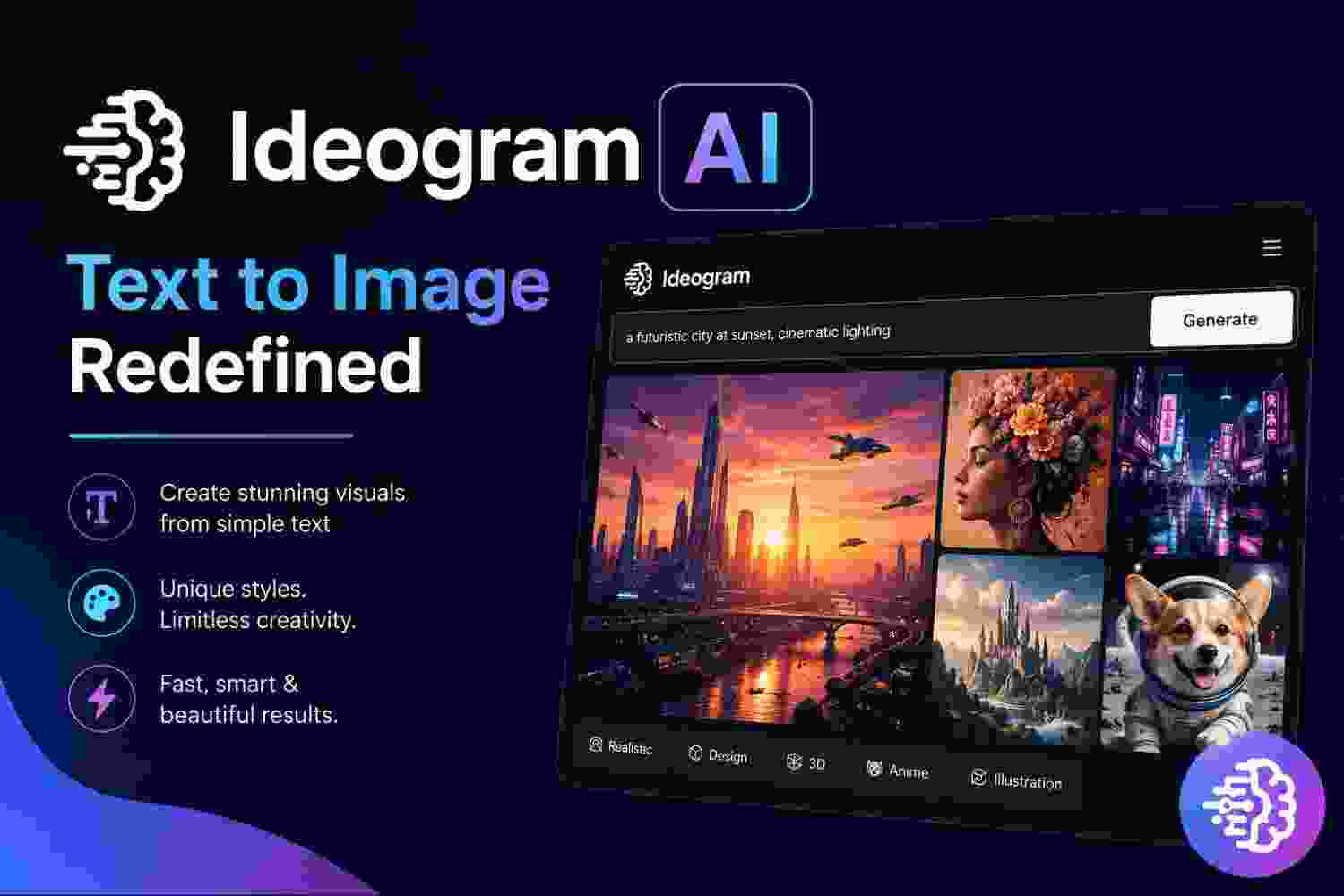
Description
Ideogram is an AI-powered generative design and image-generation platform best known for producing images with accurate, readable text. While many AI image generators are excellent at creating realistic scenes and artistic visuals, Ideogram has built a particularly strong reputation around posters, logos, typography, advertisements, social media graphics, book covers, packaging, and other designs where text is an important part of the image.
Ideogram has expanded beyond simple text-to-image generation. The platform now includes Ideogram 4.0, Canvas, Magic Fill, Extend, Remix, image editing, background removal, character consistency, editable text layers, and API access. Ideogram 4.0 was released in June 2026 as an open-weight foundation model and is also available through Ideogram’s hosted platform and API.
So, is Ideogram worth using? This detailed review examines its features, image quality, pricing, usability, strengths, weaknesses, and ideal use cases.
What Is Ideogram?
Ideogram is a generative media platform that lets users create and modify visual content using natural-language prompts.
The platform originally became popular because it was unusually good at generating legible typography inside AI-generated images. That capability remains one of its major differentiators. Ideogram currently advertises 95% text accuracy and specifically positions the technology for posters, signage, packaging, book covers, and other typography-heavy designs.
Today, Ideogram is more than an AI image generator. Its platform combines image-generation models with creative applications such as:
- AI image generation
- Poster creation
- Logo and branding concepts
- Social media graphics
- Product and packaging concepts
- Image editing
- Background removal
- Image extension
- Canvas-based workflows
- Character consistency
- Editable text layers
- API-based image generation
This makes Ideogram particularly interesting for designers, marketers, content creators, entrepreneurs, and developers.
Ideogram 4.0
The most important recent development is Ideogram 4.0.
Released in June 2026, Ideogram 4.0 is a 9.3-billion-parameter open-weight text-to-image model. Ideogram describes it as a frontier image model designed to improve visual quality, prompt adherence, typography, and production-oriented design workflows.
One notable aspect of the release is that Ideogram made the model weights available for local use under its applicable licensing terms, while also offering hosted access through its platform and API.
For normal users, however, the hosted Ideogram platform is the easiest way to use the technology without managing model infrastructure.
Key Ideogram Features
1. Excellent AI Text Rendering
Text rendering is arguably Ideogram’s biggest selling point.
Traditional AI image generators have historically struggled when asked to place specific words inside an image. You might request a poster saying “SUMMER SALE” and receive distorted letters, missing characters, or completely incorrect words.
Ideogram was designed with typography as a core capability.
The company currently claims approximately 95% text accuracy, making it particularly useful for designs containing headlines, labels, signs, advertisements, and other textual elements.
This makes Ideogram especially useful for:
- Posters
- Advertisements
- Book covers
- Event graphics
- Product packaging
- Social media posts
- Logos and brand concepts
- Website banners
- Marketing creatives
- Typography experiments
If your AI-generated image needs to communicate information through text, Ideogram deserves serious consideration.
2. Ideogram Canvas
Ideogram Canvas provides an infinite creative workspace where users can generate, organize, combine, and edit visual assets.
Instead of treating every generation as an isolated image, Canvas allows you to build a larger design workflow around multiple assets.
You can generate images, upload existing images, combine elements, and use editing tools such as Magic Fill and Extend.
This is useful for designers who want to iterate on a concept rather than repeatedly generating completely new images.
3. Magic Fill
Magic Fill is Ideogram’s inpainting-style editing capability.
It allows you to select an area of an image and replace or modify that portion using a prompt.
For example, you could generate a product advertisement and then change:
- The background
- Clothing
- Objects
- Decorative elements
- Product surroundings
- Specific visual details
This can be considerably faster than regenerating the entire image.
4. Extend
Extend allows users to expand an image beyond its original boundaries.
For example, you could take a square image and extend it into a wider composition for a website banner or social media design.
This is particularly useful when adapting existing artwork to different formats.
5. Editable Text Layers
One of Ideogram’s newer design-oriented capabilities is Layerize Text.
Instead of treating all generated typography as permanently baked into a raster image, Ideogram can extract text into editable components. Users can then modify the copy, font, and size without regenerating the entire design.
This is an important workflow improvement for marketing and graphic-design use cases.
For example, you could generate:
“25% SUMMER SALE”
and later change it to:
“50% SUMMER SALE”
without recreating the entire visual.
6. Character Consistency
Ideogram also offers character-reference functionality.
You can provide a reference image and use it to maintain the identity of a person or character across different generations. Ideogram describes this as a way to create consistent characters from a single reference image.
This can be useful for:
- Character development
- Storytelling
- Marketing campaigns
- Social media characters
- Children’s books
- Brand mascots
- Consistent creative campaigns
7. Image Remixing
Remix allows users to take an existing visual and create a new interpretation of it.
This is useful when you like the composition of an image but want to change its:
- Style
- Subject
- Environment
- Colors
- Mood
- Clothing
- Artistic direction
It provides a more iterative workflow than starting from a blank prompt.
8. API
Ideogram isn’t limited to its consumer-facing website.
Developers can access Ideogram models through an API. Ideogram 4.0 currently has hosted API pricing of $0.03 per image for Turbo, $0.06 for Default, and $0.10 for Quality.
This opens up possibilities for businesses building:
- AI design tools
- Marketing platforms
- Content-generation systems
- Automated image pipelines
- SaaS products
- Internal creative applications
Ideogram’s platform also promotes a unified API that can provide access to image and video models through a common interface.
Ideogram Pricing
Ideogram offers a free tier as well as paid subscriptions.
According to its current pricing page, the plans include:
| Plan | Monthly Price | Priority Credits |
|---|---|---|
| Free | $0 | None |
| Plus | $20/month | 1,000/month |
| Pro | $60/month | 3,500/month |
| Team | $30/user/month | 1,500/user/month |
| Enterprise | Custom | Custom |
Annual billing reduces the effective prices. For example, the current annual prices listed by Ideogram are $15/month for Plus, $42/month for Pro, and $20/user/month for Team, billed annually.
The free plan includes 10 slow credits per week, allowing users to test the service before paying.
Plus
The Plus plan is aimed at regular individual users.
It includes:
- 1,000 priority credits/month
- Private generation
- Unlimited slow credits
- Character consistency
- Larger generation queue
- Quality export
- Unlimited Canvas
For many individual creators, this is likely the most sensible paid plan.
Pro
The Pro plan is designed for heavier users.
It provides:
- 3,500 priority credits/month
- Private generation
- Unlimited slow credits
- Character consistency
- Batch generation
- Quality export
- Larger generation queue
The additional credits and batch-generation functionality make Pro more appropriate for professional creative workflows.
Team
The Team plan is intended for organizations and collaborative teams.
It provides individual credits alongside centralized billing and administration features.
Enterprise
Enterprise pricing is customized.
Enterprise customers can access features such as custom model training, higher-volume API arrangements, and priority support.
How Much Does Ideogram Cost Per Image?
Ideogram uses a credit system for its consumer plans.
The number of credits required depends on the model and rendering settings. For example, the current pricing table lists different credit requirements for Ideogram 4.0, 3.0, 2a, 2.0, and other models.
For developers using the hosted Ideogram 4.0 API, pricing is simpler:
- Turbo: $0.03/image
- Default: $0.06/image
- Quality: $0.10/image
This makes the API potentially attractive for applications generating images at scale.
Ideogram Pros
Excellent text generation
This is Ideogram’s strongest advantage. If the image needs accurate words, Ideogram is one of the first AI image generators worth testing.
Strong for graphic design
Ideogram is particularly effective for posters, advertisements, covers, packaging, and social graphics.
Powerful editing workflow
Canvas, Magic Fill, Extend, Remix, and other tools allow users to refine an image instead of repeatedly starting from scratch.
Character consistency
The character-reference feature makes it easier to maintain a recognizable person or character across multiple generations.
Editable text
Layerize Text moves Ideogram closer to a genuine design workflow by allowing generated typography to be edited after generation.
API availability
Developers can integrate Ideogram into their own applications rather than relying exclusively on the website.
Free plan available
Users can test Ideogram without immediately purchasing a subscription.
Ideogram Cons
Credit limitations
Heavy users can consume credits quickly, particularly when experimenting with many generations.
Paid features can become expensive
Professional users generating large numbers of images may need Pro or API-based usage depending on their workflow.
Not necessarily the best choice for every visual style
Ideogram’s greatest advantage is design and typography. Users looking primarily for a particular cinematic, artistic, photographic, or specialized visual aesthetic may prefer comparing its results against other leading image-generation models.
Learning curve for advanced workflows
Basic image generation is straightforward, but features such as Canvas, references, editing, and layer-based workflows require more experimentation.
Text accuracy isn’t perfection
Ideogram’s stated 95% text accuracy is impressive, but that does not mean every generation will be perfect. Users should still check generated text carefully, especially for commercial designs.
Ideogram vs Midjourney
Ideogram and Midjourney overlap considerably, but their strengths differ.
| Feature | Ideogram | Midjourney |
| AI image generation | Excellent | Excellent |
| Text in images | Excellent | Good |
| Posters | Excellent | Excellent |
| Typography | Excellent | Good |
| Marketing graphics | Excellent | Excellent |
| Character consistency | Yes | Yes |
| Image editing | Yes | Yes |
| API | Yes | Different ecosystem |
| Graphic-design workflow | Very strong | Strong |
| Photorealism | Excellent | Excellent |
If your primary requirement is beautiful artistic imagery, both deserve consideration.
If your primary requirement is accurate text inside the generated design, Ideogram has a particularly strong advantage.
Ideogram vs ChatGPT Image Generation
ChatGPT’s image-generation capabilities are useful for conversational image creation and editing, while Ideogram is particularly focused on visual design, typography, and production-oriented creative workflows.
Ideogram can therefore be an attractive specialized tool for users who regularly create:
- Posters
- Ads
- Book covers
- Product graphics
- Social media designs
- Typography-heavy artwork
The best option depends on the workflow rather than simply asking which model is “better.”
Who Should Use Ideogram?
Graphic Designers
Ideogram can accelerate concept development, poster creation, typography exploration, and visual experimentation.
Social Media Managers
It can create promotional graphics, quote cards, campaign visuals, and social-media creatives.
Marketers
Marketing teams can use Ideogram to quickly prototype advertisements, product concepts, banners, and promotional campaigns.
Authors and Publishers
Book-cover concepts and promotional graphics are strong use cases because typography is so important.
Small Businesses
Small businesses can use Ideogram to create advertising material without hiring a designer for every basic creative task.
Content Creators
YouTubers, bloggers, newsletter creators, and social-media creators can use Ideogram to generate thumbnails, illustrations, promotional images, and branded graphics.
Developers
The API makes Ideogram particularly interesting for developers who want to embed AI image generation into their applications.
Who Should Probably Avoid Ideogram?
Ideogram may not be the best fit if you:
- Rarely create images
- Only need occasional basic AI artwork
- Need a very specialized visual style available elsewhere
- Don’t need text within images
- Want a completely free unlimited image generator
For occasional users, the free tier may be sufficient. Heavy professional users should compare the total cost against competing AI image-generation platforms.
Is Ideogram Good for Commercial Use?
Yes, but users should understand the applicable terms and third-party rights.
Ideogram states that it does not claim ownership of outputs generated with its model, and its licensing information says outputs can be used commercially subject to its usage policy and third-party rights.
Businesses should still review:
- Ideogram’s current terms
- Acceptable Use Policy
- Copyright and trademark issues
- Rights relating to reference images
- Rights of identifiable people
- Commercial licensing requirements
For organizations deploying models themselves, Ideogram also provides separate licensing options for its open-weight models.
Ideogram for Businesses
Ideogram is becoming more interesting for businesses because the platform is moving beyond simple consumer image generation.
Ideogram 4.0 is available through the hosted API, while the company also offers open-weight and enterprise options. Enterprises can use custom models and deployment arrangements depending on their requirements.
This creates several potential business applications:
- Automated advertising
- Product visualization
- E-commerce creatives
- Personalized marketing
- Social media automation
- Book-cover generation
- Packaging design
- Brand-content generation
- AI-powered design software
For developers, API pricing starting at $0.03 per image can make experimentation relatively inexpensive before scaling production workloads.
Summary
Ideogram is one of the strongest AI image-generation platforms for typography-heavy and design-oriented content.
Its biggest advantage is not simply the ability to create attractive images. The real differentiator is its combination of text rendering, design composition, image generation, editing, Canvas, character consistency, and increasingly sophisticated production workflows.
Ideogram 4.0 also represents a significant development because the company has expanded into open-weight models while continuing to offer hosted generation and API access.
Subscribe To Newsletter
Get Daily AI Tools and Softwares Information to Your Email