
Description
Researching isn’t just about finding papers — it’s about understanding how ideas connect, evolve, and influence one another. That’s exactly what Connected Papers was built for. It transforms the often overwhelming process of literature discovery into a visual exploration, allowing you to see how research papers relate, cluster, and expand within a scientific field.
Let’s dive into a full, expert review of Connected Papers, the visual tool that’s reshaping how researchers explore academic knowledge.
What is Connected Papers?
Connected Papers is a research discovery and visualization platform that helps you explore relationships between academic papers. Unlike traditional search engines that rely purely on keywords, this tool maps the citation and semantic similarity between papers — showing a visual “network” that represents how ideas are connected.
It’s not just a search tool; it’s a research exploration engine that lets you visually navigate through an entire domain of knowledge, discover new directions, and identify key works at a glance.
How Connected Papers Works
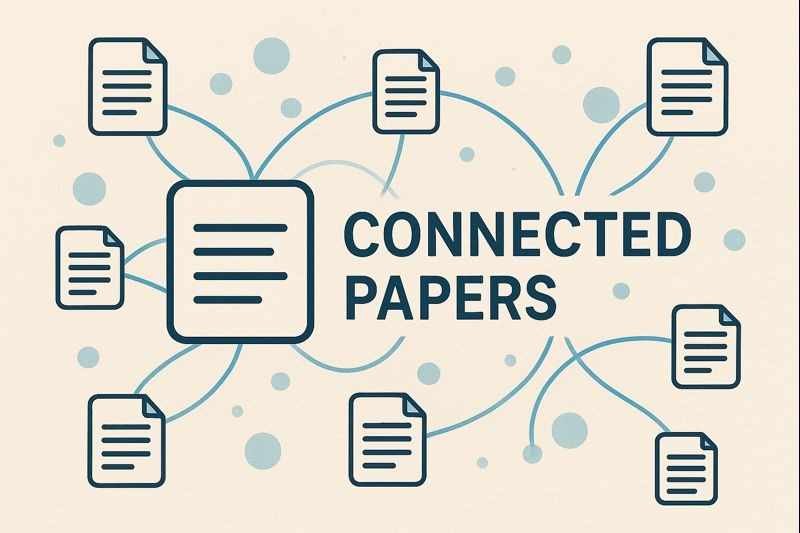
When you input a single paper or keyword, Connected Papers analyzes its co-citation network and generates a graph of related papers. Each node in this graph represents a research paper, and the connecting lines indicate semantic or citation-based relationships.
The closer two nodes are, the more conceptually related they are — enabling you to see how research topics interlink and evolve over time.
Key Features of Connected Papers
1. Visual Research Graphs
Connected Papers displays research papers as an interactive graph, where you can visually explore related studies. It helps identify clusters of research around specific themes, and you can follow these visual trails to uncover seminal works and recent breakthroughs.
2. Co-Citation and Similarity Mapping
The system doesn’t just rely on simple citations — it uses co-citation analysis and semantic similarity. This means that even if two papers don’t cite each other directly, Connected Papers can detect conceptual similarities and show their relationship.
3. Backward and Forward Exploration
You can easily explore prior works (foundational papers) and derivative works (newer studies) connected to a given paper. This two-way exploration helps you understand both the roots and the evolution of a research idea.
4. Filter and Focus Tools
The platform allows you to filter papers by year, title, or relevance, and focus on specific sections of the graph. This keeps your research organized and targeted, even when dealing with large fields.
5. Direct Access to Metadata and PDFs
Each paper node provides direct links to Semantic Scholar, arXiv, or other sources where you can access abstracts or full texts. This saves time and reduces the need for jumping between multiple platforms.
Benefits of Using Connected Papers
-
Saves Time: Quickly visualize relationships between papers instead of manually checking citations.
-
Discover Hidden Connections: Find relevant works that traditional keyword searches might miss.
-
Understand Research Evolution: See how a concept has grown and diversified over time.
-
Great for Literature Reviews: Build comprehensive, well-structured literature lists effortlessly.
-
User-Friendly Interface: Minimal, clean, and highly intuitive design for visual learners.
Who Should Use Connected Papers?
-
🎓 Students: Ideal for writing dissertations and identifying key foundational papers.
-
🔬 Researchers: For discovering related works and mapping new research directions.
-
👩🏫 Professors & Academics: To stay updated on how their field is evolving.
-
🤝 Research Teams: For collaborative literature exploration and topic visualization.
Pros and Cons of Connected Papers
Pros:
✅ Intuitive and elegant visual interface
✅ Accurate citation and similarity-based mapping
✅ Great for literature discovery and topic visualization
✅ Free to use and browser-based (no installation required)
✅ Helps find both classic and emerging research works
Cons:
❌ Limited customization in graph visuals
❌ No built-in reference manager integration
❌ Dependent on data availability from Semantic Scholar
❌ Works best for fields with rich citation networks
Pricing and Accessibility
Connected Papers is completely free to use.
There’s no subscription or sign-in requirement — you simply enter a paper title or link, and the platform instantly generates the research graph. Its accessibility and simplicity make it one of the most user-friendly academic tools available today.
How Connected Papers Compares to Other Tools
While tools like ResearchRabbit focus on personalized recommendations and collection management, Connected Papers excels in visualizing the structure of a research field. It’s a perfect companion for anyone who wants to see the bigger picture before diving deep into specific studies.
Is Connected Papers Worth Using?
Absolutely.
Connected Papers is one of the most innovative and visually engaging research tools for modern academics. It bridges the gap between citation databases and creative exploration by letting you see how research ideas connect, branch, and evolve.
For anyone conducting a literature review or exploring a new research area, Connected Papers offers unmatched clarity and discovery efficiency.






Reviews
There are no reviews yet.